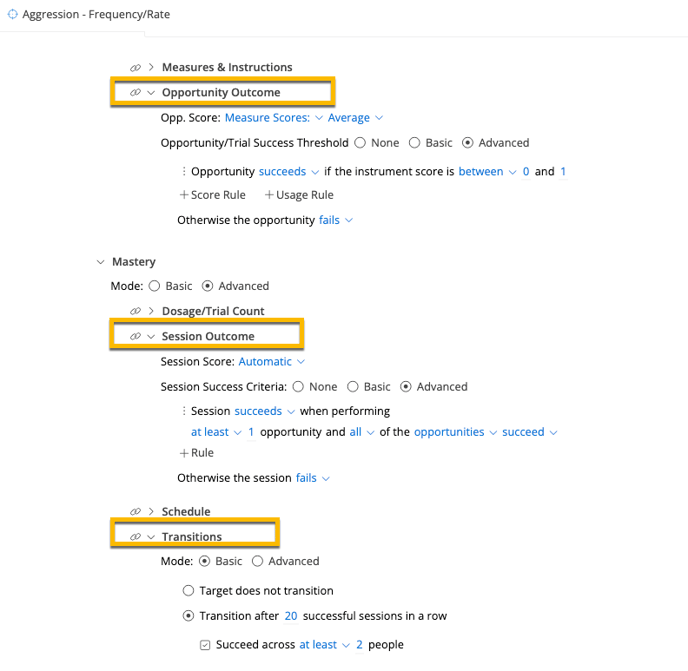
When automation is desired, Motivity needs clear instructions for:
-
Opportunity Outcome (what makes an opportunity successful)
-
Session Outcome (what makes a session successful)
-
Transition Rules (what criteria must be met to transition to the next phase, such as maintenance)
These three areas work together to determine whether a behavior-reduction target is successful and when it should transition.
1. Set Up Your Opportunity Outcome
Behavior-reduction targets treat each session as one opportunity.
In this area, define the frequency threshold that counts as a successful opportunity.
Examples of success definitions:
• Frequency equals zero
• Frequency is at or below a chosen maximum value
Success occurs when the frequency meets the threshold.
Failure occurs when the frequency exceeds it.
This is the first required configuration if you want automated monitoring.
2. Set Up Your Session Outcome
After opportunity success is defined, Motivity must know when an entire session should be considered successful.
For behavior-reduction targets:
A session is successful if it contains at least one successful opportunity.
Since each session includes only one opportunity, this means:
• If the opportunity meets the success threshold, the session is successful.
• If the opportunity does not meet the threshold, the session is unsuccessful.
This is the second required configuration for automated monitoring.
3. Set Up Your Transition Rules
Transition rules determine whether the target masters or moves into a maintenance (or the next listed) phase.
This is where you specify:
• How many successful sessions are required
• Whether those sessions must be consecutive
• Any other conditions that define mastery or advancement
Important clarification:
At this time, Motivity cannot evaluate mastery across days. It can only evaluate across sessions.
Note: Because behavior monitoring often occurs over long periods of time, many BCBAs choose not to automate transitions for reduction targets. Instead, they visually monitor behavior trends and use clinical judgment during treatment planning and graph analysis to determine when mastery has been met.
This is the third configuration area, used when you want automatic transitioning.
Summary of the Three Separate Configuration Areas
Opportunity Outcome
Defines whether the recorded frequency meets the success threshold.
Session Outcome
Defines whether a session is successful by requiring at least one successful opportunity.
Transition Rules
Defines when mastery occurs and whether the target automatically transitions. Transition rules operate across sessions, not across days.