
Overview
Roles define the different provider categories in your organization and set the hierarchy used for billing, compliance, supervision, and assigning the right staff to the right clients. Getting these right ensures your organization runs smoothly, your claims go out correctly, and your providers are set up for success.
Understanding Roles
Roles represent the clinical and non-clinical positions your staff can hold. Think Licensed Provider, BCBA-D, BCBA, OT, SLP, BCaBA, RBT, BT, and so on.
Each role can include important details such as taxonomy codes, supervision requirements, access levels, and compliance criteria.
Roles also determine the hierarchy Motivity uses when a provider has multiple credentials, ensuring the system uses their highest applicable role for billing.
Accessing Roles
-
Navigate to the Admin module.
-
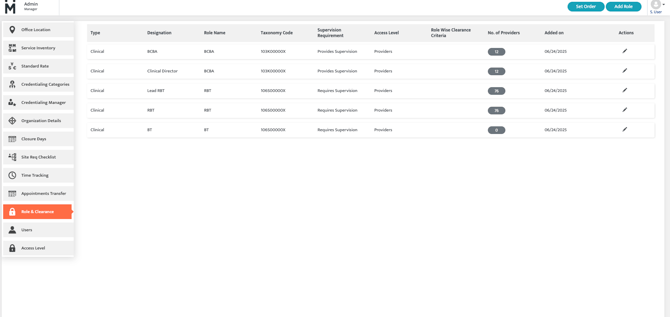
Select Roles and Clearance to open the full list of roles in your organization.
Adding a New Role
-
In the top right, click Add Role.

-
Select Type: Choose Clinical or Non-Clinical.
-
Clinical: Allows the user to provide and bill for clinical services.
-
Non-Clinical: Restricts the user from providing clinical services.
-
-
Enter a Role Name
-
For Clinical Types: Use the credential required for billing (e.g., BCBA, RBT, SLP).
-
For Non-Clinical Types: Use the professional title (e.g., Administrator, Biller, Intake Coordinator).
-
-
Fill in the additional fields:
- Criteria – Requirements for the role (e.g., “Clinical Supervisors must have a BCBA”). You may add multiple criteria depending on regulations.
-
Taxonomy – Used on claims when certain payors require it.
-
Supervision Settings – Whether the role requires supervision or provides supervision.
-
Designation – Job title. A role can have multiple designations.
-
Access Level – Defines what a user with this role can access in the system. (See the Access Level article for more details.)
-
Click Save.
Roles vs. Designations
Roles may have multiple designations while designations can only be applied to any one role at time.
Role: Defines the provider's billing credential or professional title.
-
For Clinical Staff: This dictates the role that appears on insurance claims (e.g., BCBA, RBT).
-
For Non-Clinical Staff: This represents their administrative or professional title (e.g., Biller, Admin).
Designation: Defines the user's job title.
-
A designation describes what a staff member does within the organization (e.g., Scheduler, Clinical Director, Lead RBT, Supervisor, BCBA).
- Roles and Designations may share the same name if applicable (e.g. An organization can have a BCBA role and a BCBA designation).
Why This Matters
Many staff members hold more than one responsibility. Someone may work as a Scheduler but still hold an RBT credential.
-
Their designation tells your team and Motivity what their job title is.
-
Their role tells Motivity how to bill them if they provide clinical services.
This ensures accurate billing while still reflecting each employee’s actual title.
Examples
-
Scheduler (Designation) + Scheduler (Role)
→ They do not provide clinical services. They will not be used for clinical work. -
Scheduler (Designation) + RBT (Role)
→ Their job is scheduling, but if they step into a session, Motivity bills them as an RBT. -
Clinical Director (Designation) + BCBA (Role)
→ Their title is Clinical Director, but when delivering clinical services, they are billed as a BCBA.
Editing Existing Roles
You can edit any existing role to adjust its details by clicking the pencil icon next to it, under "Actions". Each role displays how many staff members are assigned to it and includes a tile where you can update criteria, supervision settings, access information, and more.
Important: For all supervisor-level roles, make sure "Assignable as Patient’s Primary Supervisor" is selected. This allows these roles to be designated as the supervising provider for a client.
After making updates, click Update to save your changes.
Setting Role Hierarchy (Highest to Lowest)
Your role hierarchy matters, especially for billing compliance and concurrency rules. Motivity will always use the provider’s highest applicable role when multiple are assigned.
To set the hierarchy:
-
In the top right, click Set Order.
-
Drag and drop roles into the correct order, placing the highest-level credential at the top.
-
Click Save to lock in your ordering.
This ensures clean billing logic and accurate provider assignment behavior across the system.
Updated 12/8/2025 by Amanda Kelly